 1 / 9
Tiger Face Clipart: 30 Tiger Heads from Roaring and Profile Views to Faceted, Cartoon, Stencil and Ink Styles in Color and Mono
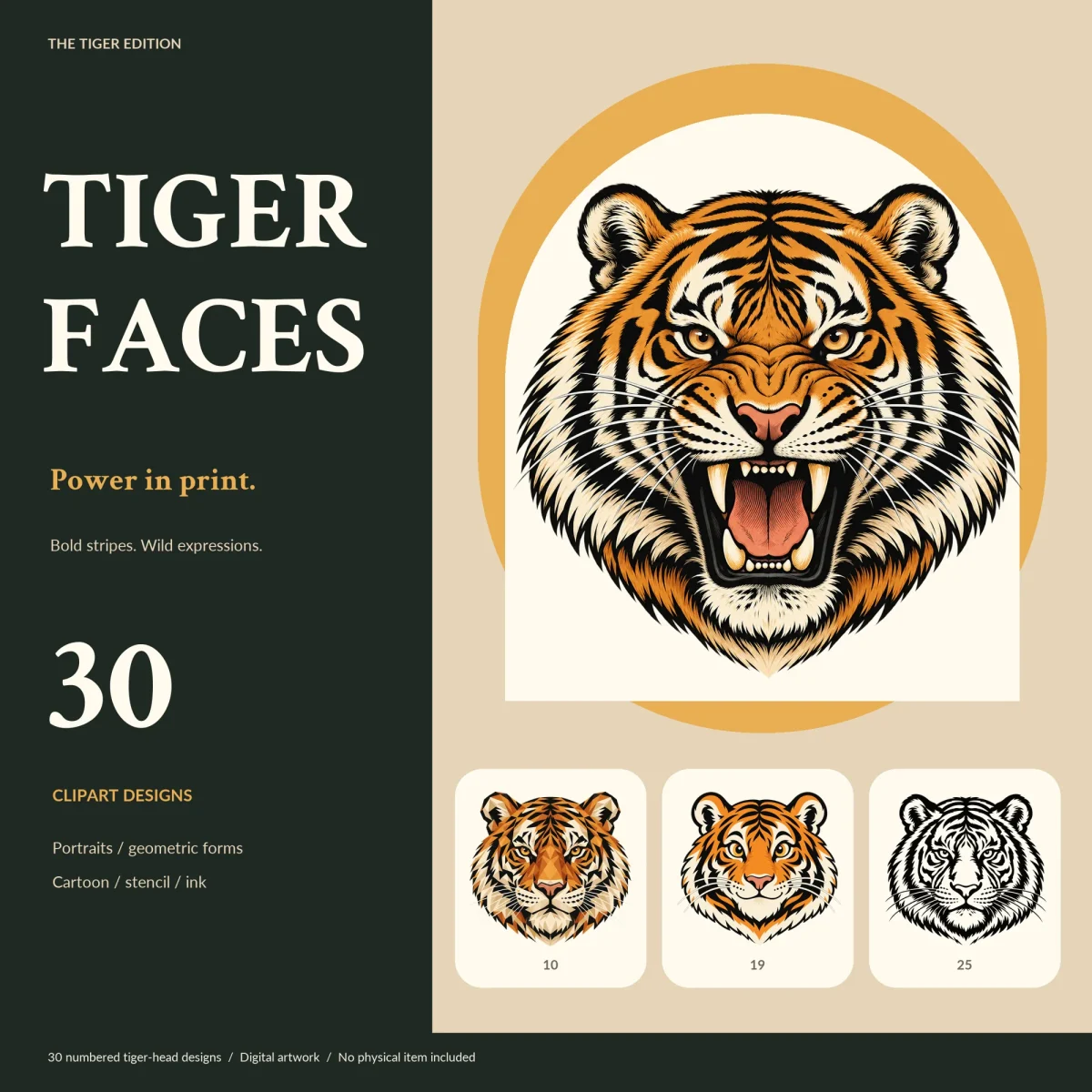
Thirty tiger heads cropped at the neck, in orange, ivory and black, grouped three to a style, from open-jawed roars and side profiles to angular faceted planes, big-eyed cartoon faces, black stencil cutouts and fine black-and-white ink. Every head also comes as a one-color mono version.
$4.99
Buy any 3 or more printables and save 20% at checkout.
- Download right after payment — link works for 30 days, up to 5 downloads
- Files arrive as a ZIP with your license PDF inside
- Secure checkout by Stripe · Refund policy
The clipart here is tiger heads and nothing else, with no bodies, paws or scenery, just the face, ears and ruff of fur, cut off at the neck. All thirty share one palette of burnt orange, ivory and near-black, and what changes from group to group is the treatment, so you can pick a snarling head, a quiet one or a cartoon one and still have them look like they belong together.
Ten treatments, three heads each
The roar group (01–03) has the jaws wide open with every fang and a pink tongue showing: one straight on, one with the chin pulled down, one with the head tipped up and to the side. The profiles (04–06) face left, look up to the right, and look down to the right. 07–09 keep the mouth closed: a direct front stare, a three-quarter turn and a heavier-lidded front view.
From there the stripes start doing different things. In 10–12 the fur is broken into angular facets, like a low-poly model, with the triangles in orange, cream and black. In 13–15 the stripes stretch into long sweeping curves with a clean outer edge. 16–18 carry the most fur texture and soft shading, the closest thing in the set to a detailed wildlife portrait. 19–21 are cartoon faces with simpler shapes, larger eyes and a thick black outline: a smile, a roar and a curious head tilt. 22–24 are bold, poster-like heads with strong black stripes, a front view, a three-quarter snarl and a full roar.
The last six drop the orange. 25–27 are stencil heads made only of black shapes, and 28–30 are fine black-and-white ink drawings with dense fur lines.
Mono and DXF versions
The mono file of each head is the same design in one dark ink, a warm near-black, with everything else transparent, so it reads as stripes, eyes and an outline. That suits one-color jobs such as a single screen-print layer, a stamp or vinyl. The DXF is a further simplified single-ink version on one layer, made of closed shapes, in inches. The heads sit inside a 12-inch square area and span roughly 8.8 to 9.8 inches on their longest side when opened.
Size and file notes
The PNG canvas is 3600 pixels square, and the head itself fills about 2,700 to 3,000 pixels of it, with transparent space around. The guide suggests starting near 9 to 11 inches wide on an adult shirt, and 2.5 to 3 inches high for a single motif on a mug. The SVG and EPS files are vector redraws: fine fur and soft color blends are flattened into solid shapes, so the vectors look a little flatter than the PNG. For the textured heads, 16–18 in particular, the PNG keeps more of the shading.
Questions
- Are the stencil and ink heads in color too?
- Not in the orange sense. The color files for 25–27 are black stencil shapes with soft gray shading, and 28–30 are black linework over white fur. Their mono versions keep the same marks in one dark ink, with the white left see-through.
- Which file should go to a cutting machine?
- The DXF. Each one is the single-ink version of a head, traced as closed shapes on one layer, in inches, and it opens about 9 to 10 inches across. Whiskers and fur tips are the thinnest parts, so cut one head small on scrap first and size up or simplify where the gaps close.