 1 / 6
Pony Bead Patterns: 20 Woodland Animal and Camping Keychains with Row-by-Row Weaving Recipes
Fourteen animals and six camping pieces, from an axolotl and a hummingbird to a tent and a lantern, woven row by row on a doubled cord into palm-size keychain charms. Every design has a lacing chart, a row recipe with bead counts, and cord estimates for standard and mini pony beads.
$3.99
Buy any 3 or more printables and save 20% at checkout.
- Download right after payment — link works for 30 days, up to 5 downloads
- Files arrive as a ZIP with your license PDF inside
- Secure checkout by Stripe · Refund policy
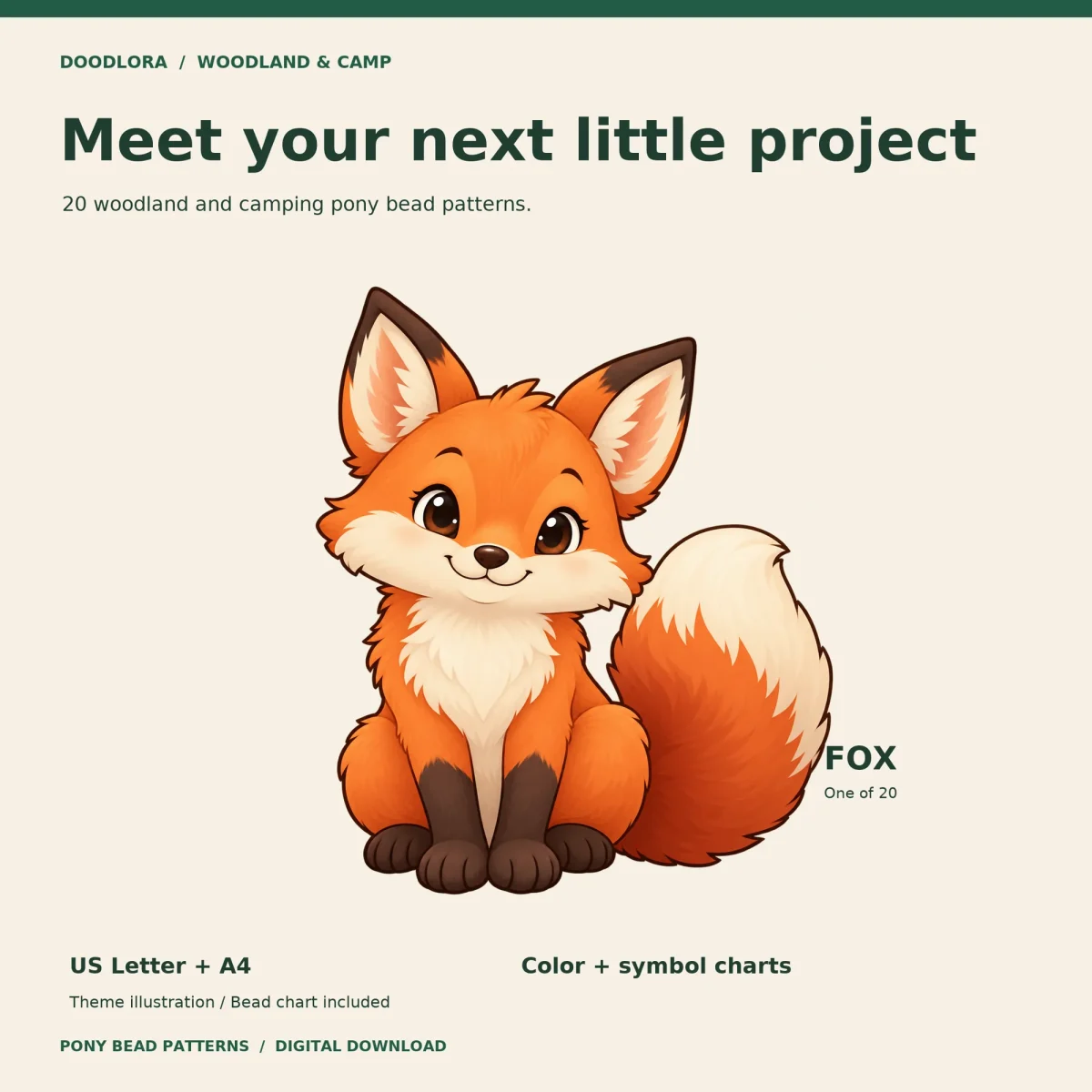
Woodland & Camp is 20 pony bead keychain patterns, woven row by row on one cord folded in half, with no iron or pegboard involved. Fourteen are animals: an axolotl, hummingbird, fish, frog, turtle, fox, owl, bear, rabbit, butterfly, ladybug, bee, hedgehog and raccoon. Six are camping things: a tent, a campfire, a pine tree, a lantern, a backpack and a spotted mushroom.
How the weaving works
You fold the cord, attach it to a keychain ring with a lark’s head hitch and keep both tails equal. For each row, the left tail picks up the beads in the printed order and the right tail passes back through the same beads, so every bead carries both cords. Rows widen and narrow as the shape needs, and the picture keeps facing you the whole way down. Pages 3 to 6 cover the materials, the two-cord repeat, the finishing knot at the center of the last row, and what to do if a row curls or droops.
Clear support beads
Many designs use clear beads, marked 0 on the charts, to bridge gaps between ears, wings, fins and tails and keep each row centered. They stay in the finished charm. The hummingbird is the extreme case: 104 of its 218 beads are clear. Three designs use none, the Tent, Mushroom and Bee, and the book suggests starting with those. It names the Fish, Hummingbird, Turtle and Pine tree as the ones where wide rows and sudden changes are most likely to flex, so make a sample of those first.
Size and cord
These are big charms, not tiny zipper pulls. On standard pony beads (about 9 x 6 mm) they come out 4.5 to 5.0 in wide, and the tallest, the Lantern, is about 8.1 in long; on mini beads (about 6 x 4 mm) they are 3.0 to 3.3 in wide. The Tent is the smallest at 132 beads in 12 rows, and the Lantern the largest at 363 beads in 23 rows. Each recipe gives a cut length for one continuous cord, from 120 in (305 cm) for the Tent to 270 in (686 cm) for the Lantern at standard size. The book suggests nonstretch braided beading cord, about 0.03 in (0.8 mm) for standard beads or 0.02 in (0.5 mm) for mini, thin enough that three passes fit through one bead.
Charts, recipes and colors
Each design takes two pages. The lacing chart shows the shape bead by bead with the row number and bead count down the sides, next to a small picture of the subject. The recipe page writes each row as a string of letters, gives the quantity of every color, and ends with the exact finishing steps for that last row. Colors are generic names such as cream, charcoal, coral, forest green and golden yellow, with N for orange and 0 for clear. The Color and Symbols books share the same page order, and the Symbols book draws the beads as letters on white for a black-and-white printer.
The illustrations
The 20 PNGs are soft cartoon pictures of each subject on transparent backgrounds, 1,254 pixels square. They show the animal or object, not a beaded charm, and the bead version is a simplified layout of it. Build from the chart and recipe.
Small parts make these unsuitable for children under 3, and children need an adult nearby. Keep loose beads and long cords away from young children. Beads, cord and keychain hardware are not included.